What’s this? Am I not already writing a novel?
Well, yes, but I want to tell you a bit about this new novel. I suppose you could say this blog is an attempt at transparency, at explicating what it means to be a writer, at what goes into writing books.
My wife is not a writer but she got the idea for a novel and it keeps needling at her. She wants to tell this story or at least find a way to wrap her arms around the story, but she’s never sat down to work on a long project like a novel.
In her defense, most people haven’t (and shouldn’t!), but because she keeps thinking about it and developing it, I told her that I’d write it for her. So over the last few weeks, we’ve talked about it intermittently. I help her come up with concepts and a framework for the world and the politics that stand as a backdrop to the story she wants to tell. I went so far as to help her organize her thoughts into an outline.
Those who know me, and who have read these Writing Diaries here, know that I’m not much for outlines. I just don’t use them. Never been able to stick with one and actually turn it into a novel. Usually I lose interest as soon as the outline is done. I’ve said before that discovery is really the pure ecstasy of writing, and an outline solves a lot of the discovery. And so my motivation just evaporates as soon as the outline is on the page.
But this is a bit different. For one, I’m not writing this for me. If I was, the outline would be unnecessary. But because I’m writing it for my wife, love will likely sustain me as we move forward and through the novel.
In truth, part of what sparked my interest in this novel idea was her talking about something like the French Revolution as a backdrop, with the first scene taking place at a public execution.
Few ideas have ever felt so very much like they were meant for me. The most surprising thing about this concept, or at least this setting, is that I didn’t come up with it myself.
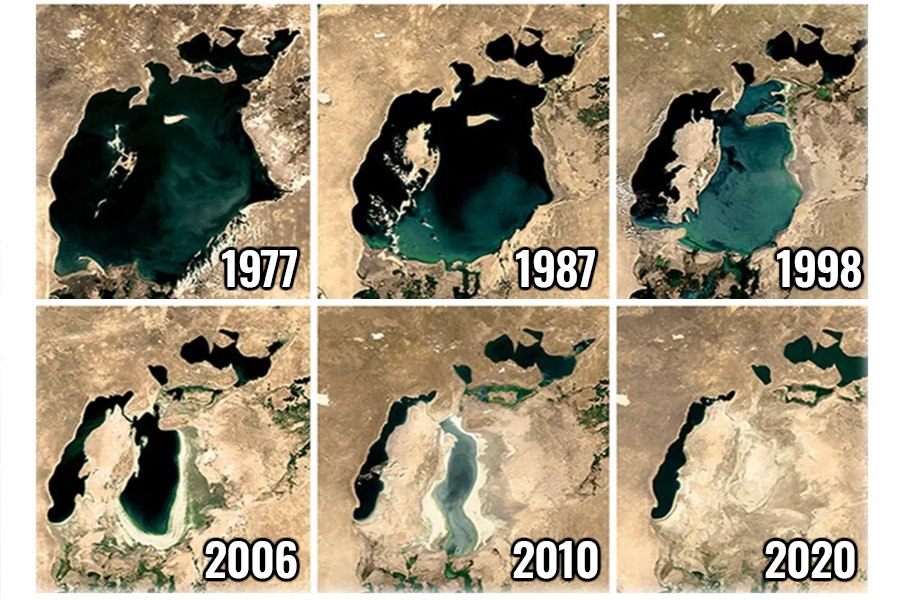
Anyway, she mentioned a prologue for the first time yesterday, which is inspired by the Aral Sea, which I knew nothing about. It’s something that’s also been stuck in her head for a long time, and, again, it’s something that feels like it already belongs in my head. The exact kind of image and occurrence that would drive me wild, lighting my brain on fire. And so I thought I’d take a crack at writing this prologue.
With that in mind, below, you will find the first draft of the prologue to a novel cowritten with my wife that I’m currently just calling Scarlet, which may someday make sense to those who regularly drop by this site to read my thoughts about writing.
The Dead Sea
She stood at the shore that was no shore but a vast expanse of salt and sand and bone. “I remember the waves. I remember the salt breeze and the fishful nets my father dragged onto his boat.” She looked down at her daughter, her black hair blowing in the dry wind, then back out to the sea that was no sea where men and women and children harvested the salt to sell to the Parisii far to the north and the west. She shielded her eyes and squinted into the suns shining.
The deep hum of the server farm thrummed through the air, through the earth, and even in her chest. There was once a forest there. Root and stone and green leaves. Red leaves. A rainbow of leaves.
“Where did it go?” Her daughter’s voice a chirping bird. She remembered them too, the way they seemed to swim through the air as they went from tree to tree and off into the skies. The huge white gulls squawking and screaming as they stole fish right out of her uncle’s nets.
She remembered them so clearly. When she closed her eyes, she could almost hear them. “The sea shrank away. People far away drank it up.”
She scowled. Her little girl. Such heavy thoughts.
She did not know. Did not know how to explain.
Eran gestured towards the vast thrumming building of iron and plastic. “They bled it dry to feed their iron god.”
She scowled at her brother. “It’s not iron.”
He squatted down in front of his niece. “They built a god in their temples of glass and iron whose thirst cannot be sated. They built it with a thousand thousand wires all crisscrossing like the weave of your dress.” He pinched her sleeve between thumb and forefinger of his only hand. “It burns hot as both suns nooning so they bathe it in waterfalls in a place where there’s not a single waterfall, so they reached their arms way out here,” he showed her with his own long arms wrapping round her, “and grabbed it all up!”
She squealed as he lifted her into the air, spinning her round and pretending to drink her dry. “And when they were done,” he turned towards the vast nothing stretching before them, into the red rising sun, “they reached their arms to some other sea to suck dry. That’s why we fight.”
“Eran,” she hissed.
“It’s why we fight, Margalit.”
She clenched her jaw and held in her anger until they were back home peeling eggs for Margalit’s lunch.
“It is why we fight,” he said, and she heard the shrug in his voice. “You can’t hide it from her. This is the world she’s going to grow up in. The one we’re fighting for will belong to her.”
“She’s six.”
“How old were we when dad was murdered?”
She shook her head. “I know you know how different that was.” She brought the plate of cut up boiled eggs to Margalit. “Here you go, sweetness. Drink your milk too.”
“Give her some bread,” Eran yawned. “Bread and honey. It’ll make the goat milk palatable.”
“Yeah!” Margalit chirped, pushing away the plate of eggs. Samuel and Nava followed along, pushing away their bread and honey in solidarity.
“She can’t,” she said to her brother. “You can’t,” she said to her daughter.
“Why do Sammy and Nava get bread?”
She sighed heavily and took a breath. Her anger wasn’t for her daughter, but for her brother. Perhaps, a bit, towards God. Bending down, she stroked Margalit’s cheek and smiled. “You need special food to stay strong. Your brother and sister don’t. Sweets make you sick.”
“Ah, right,” Eran said as he slathered honey over his own dark bread. “Sorry, May May.”
“May May!” said Samuel and Nava opened her toothless mouth wide in a smile.
If she could wrap her arms around a moment, if she could still time and keep it all in place, she would have held it there, with her children laughing, smiling, food in their bellies.
Margalit poked at her eggs with her finger. “Can I have dip?”
When the earth rolled away from the suns and the seven moons opened their eyes wide in the vast canopy of night, she looked for Osher. She was not alone in the waiting.
Long ago, when the sea waves crashed against the shore and the pier, she watched her aunts wait for their husbands. Endlessly staring out to sea, waiting for word, waiting for sign of their return. She remembered the explosive joy, the way they’d weep and wail at the sight of the ships and their sails on the horizon. Long months spent without their men, without their loves, wondering if they’d ever come home.
The happy tears and these men cast out to sea and the distant oceans sweeping their women up in their arms imprinted on her powerfully as a girl, but what she remembered most were those women left standing there, alone.
“Please, come home,” she whispered to no one, to the eyestinging wind. Perhaps to God. A prayer. And then she took the cup full of goat milk and threw its contents out before her in an arc, spreading like a small and ephemeral sea of stars before splashing down into the arid dirt.
She heard the splashing milk of other wives and mothers. Heard the distant chatter, the quiet laughter to mask the gnawing terror.
A ritual. A prayer.
As the night deepened and silence fell heavily, they returned by ones and twos. Like shadows in the night shambling home with new cuts or bruises or limps.
Didn’t matter.
All that mattered was that they came home. That they kept coming home.
And when she saw him, her throat seized and her heart raced and she ran to him.
His brother Stav held him up as he limped home. When he saw her, he smiled like a lamb and took his arm from around his brother’s shoulder. “Miss me?”
She slapped him on the chest hard enough to turn everyone towards the two of them, then she threw her arms around him and tried not to sob with tears already flowing down her cheeks. “You’re home. You’re here.”
“I’ll always come home, my love.”
She leaned back and stared up into his face.
Stav cleared his throat and wished them goodnight and turned towards his own home, towards his own waiting wife who would bite back tears and bitter words, too relieved to let her anger swell and storm.
He put his palm to her cheek and thumbed away her tears. She put her right hand to his left cheek. First gently, and then she slapped him.
The shock on his face was worth it, almost. Mouth open wide, he gripped her waist and pulled her close and kissed her.
Kissed her like they were kids again, sneaking beneath the pier or into the goneaway forest where none would see them, where they could be alone, even if only for a moment.
“Is it over?”
He snorted. “It’s never over.”
“Don’t say that.”
“They are terrified.” He smiled. Boyish still. “They’re giving up the frontiers and falling back to Parisii. They think their artificial god will save them.” He spat behind him into the wind, loosening his grip on her to ward off devils with his left hand. “They believed they were lions.”
“Are they not?”
“Perhaps.” His smile spread wider. “But even a lion cannot fight a thousand thousand jackals. No, this is all ending. It’s all–”
But he never spoke those next words and even decades later, she often wondered what they were going to be.
The night erupted in light. A blaring bright that cast his face ghastly as his pupils shrank to pins and the great bellowing boom of a dying artificial god cracked open the night, knocking her and Osher to the ground. Her ears ringing, she scrambled back to her feet and turned to see the world on fire, the ablaze.
She heard nothing. Not even the cries of her children woken from their sleep to shattered windows and tiny cuts on their hands and faces from glass shards like shrapnel.
Osher ran past her, towards the fire, and she screamed at him. A silent scream, heard by no one, not even herself. She felt it rip her throat and lungs raw but he did not turn as he disappeared into the blazing night.
When she rushed inside to her children, she found Margalit seizing in her bed. Holding her down, she held her close while Samuel and Nava screamed in their cribs, only a few feet away.


Leave a comment